Namaste everyone! 🙏
Let me take you back in time about ten or fifteen years ago in Nepal. It feels like a different lifetime now, doesn’t it?
Do you remember the struggle of paying your electricity or water bill? It wasn’t just a chore; it was a mission. You would have to take half a day off work, travel to the NEA (Nepal Electricity Authority) office, stand in a line that wrapped around the building, and pray the counter didn’t close for lunch just as you reached the front. I can still picture the dusty counters, the piles of ledger books, and the grumpy faces of people who had been waiting for hours.
Or what about sending money to family in the village? You’d have to find someone traveling there—a distant cousin, a neighbor’s friend—and trust them with a wad of cash. Or you had to deal with expensive wire transfer services that took a big chunk as fees.
Well, I don’t know about you, but I barely remember the last time I touched actual paper money. Nepal is going through a quiet revolution. It’s not a political one with strikes and speeches; it’s a digital one. And it is happening right inside our pockets, on our smartphones.
Today, I want to deep-dive into how apps like eSewa, Khalti, and IME Pay are totally transforming how we live, how we handle our money, and how they are powering our economy from the ground up.
The Early Days: From Skepticism to Necessity
It wasn’t an overnight change. When digital wallets first appeared on the scene, the skepticism was palpable. We Nepalis are cautious with our money, and for good reason. The idea of trusting a “virtual wallet” on a phone with our hard-earned rupees seemed risky to many, especially our elders. “Is my money safe on a phone?” “What if I lose my phone?” “What if the company runs away with my money?” These were common questions.
The initial adoption was driven by convenience for small things. Remember buying recharge cards? Scratching off that silver coating and then dialing those long numbers, only to be told “incorrect number” and having to start all over again? Digital wallets solved that instantly. You could top up your phone balance in seconds, anywhere, anytime. That was the gateway. Once people got comfortable with small transactions like mobile top-ups, they started exploring other features.
The Big Players: More Than Just a Wallet 📱
Today, these platforms have evolved from simple top-up machines into giant financial ecosystems. They are like mini-banks in your pocket.
- eSewa: The pioneer. They were the first to really push this concept in Nepal. They have a massive network of agents across the country, which was crucial in the early days for people to load cash into their digital wallets. Their app is packed with features, from booking bus and plane tickets to paying school fees and insurance premiums.
- Khalti: The challenger that brought a fresh perspective. Khalti focused heavily on user experience and a clean interface. They also introduced an open API, allowing developers to integrate Khalti payment into their own websites and apps easily. Their cashback offers and movie ticket booking integration with QFX cinemas made them very popular among the younger crowd.
- IME Pay: Backed by the giant IME Group, which is synonymous with remittances in Nepal. They leveraged their existing network to make it incredibly easy to receive money from abroad directly into your wallet. They have also been aggressive in expanding their merchant network.
Now, you can do almost anything: pay your internet ISP, buy movie tickets without queuing at QFX or Big Movies, pay your taxes online (a huge relief!), and even make investments.
The Visible Change: The QR Code Revolution 🥦🚕
But the most amazing, visible change for me isn’t on the app screen; it’s on the streets. Walk down any busy street in Kathmandu, Pokhara, Biratnagar, or even smaller towns like Itahari and Dhangadhi. You will see them everywhere.
Those little red Fonepay or purple Smart QR stands have become as common as dustbins (actually, more common than dustbins!).
It started with bigger shops, but now it’s everyone. The auntie selling vegetables (tarkari) on the roadside, the taxi driver, the small tea shop (chiya pasal), even the temple priest accepting donations—they all have a QR code.
This is a massive psychological shift. It means that digital payments are no longer just for the “educated” or the “rich” people who shop in malls. It’s for everyone.
I remember a recent trip to Ason market in Kathmandu. It’s one of the oldest and busiest markets, always chaotic and crowded. I was buying some fresh spinach from an elderly lady. When I asked for the price, she pointed to a QR code stand next to her vegetables and said, “Scan garnus na, babu” (Just scan it, son). I was blown away. A woman who has likely spent her whole life dealing in cash is now part of the digital economy.
Take a look at this scene, which is now a daily reality across Nepal:
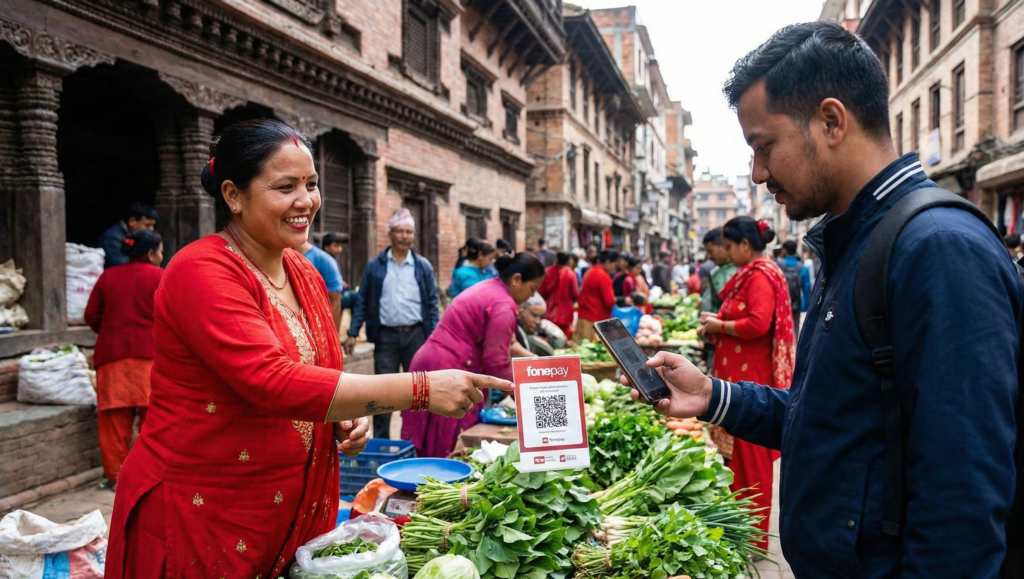
It’s not just convenient; it’s safer. Vendors don’t have to worry about carrying large amounts of cash at the end of the day. They also don’t have to worry about finding change (chutta paisa), which used to be a perennial problem in Nepal. “Change chhaina” (No change) was the anthem of every shopkeeper. Now, with exact digital payments, that problem is gone.
Solving the “Cash on Delivery” Headache for E-commerce 📦
Let’s talk about shopping online. When platforms like Daraz and SastoDeal first started gaining traction, their biggest nightmare was “Cash on Delivery” (COD).
For a long time, Nepalis didn’t trust paying online before getting the product. What if the product is fake? What if it never arrives? So, COD was the only way. But COD is a logistical headache for businesses.
Think about it:
- The delivery rider has to carry a lot of cash, which is a security risk.
- The customer has to have the exact cash ready, which often they don’t.
- The rider has to find change.
- The e-commerce company has to wait for the rider to return to deposit the cash, which slows down their cash flow.
- Sometimes, customers would order something and then refuse to pay when it arrived, causing losses for the seller.
Digital wallets have been a game-changer here. Now, you can pre-pay for your order seamlessly. This builds trust. You know your money is safe because these platforms have buyer protection policies.
Even if you still choose COD, the process has changed. When the delivery rider arrives, you don’t need cash. You just whip out your phone, scan the rider’s QR code, and pay instantly. It’s safer for the rider, and easier for you.
This single change has massively accelerated the growth of e-commerce in Nepal. It’s enabled small businesses to sell their products online without worrying about the complexities of cash handling.
Here is a common sight in our neighborhoods now:
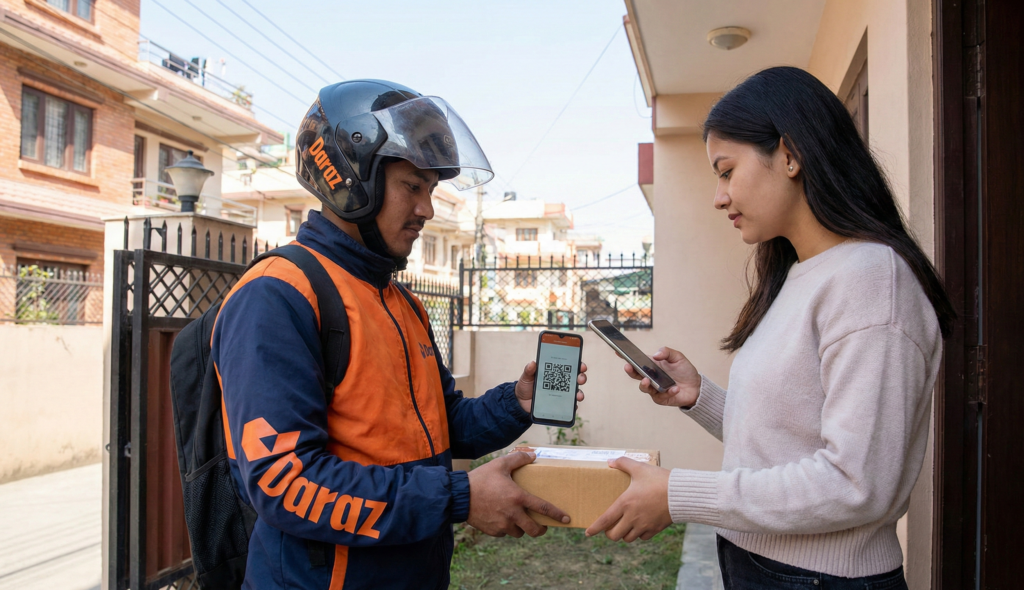
No fumbling for change, no security worries. Just a quick scan, a smile, and the transaction is done.
Financial Inclusion: Reaching the Unbanked in Rural Nepal 🏔️
This is the part that makes me the happiest. The most profound impact of digital wallets isn’t in the cities; it’s in the villages.
For decades, “financial inclusion” was a buzzword in government reports. The reality was that for millions of Nepalis living in remote hills and mountains, a bank was a distant dream. To visit a bank branch often meant a full day’s walk, or an expensive jeep ride to the nearest district headquarters.
This meant that people in rural areas were excluded from the formal economy. They couldn’t save securely, they couldn’t access loans easily, and they were reliant on informal, often exploitative, money lenders.
Then came the mobile phone, and with it, the digital wallet. Suddenly, you didn’t need a brick-and-mortar bank branch to have a bank account. Your phone was your bank.
A farmer in a remote village in Rolpa or Kalikot can now receive money sent by their son working in Dubai or Malaysia instantly. They don’t have to travel to the city to collect it. They can use that money to pay their electricity bill from their own porch. They can buy seeds and fertilizers by paying the local supplier digitally.
This has brought millions of people into the formal financial system. It’s empowering. It gives people control over their finances. It allows them to build a digital financial history, which could eventually help them get small loans to start a business or improve their farm.
I love this image. It speaks volumes about this transformation:
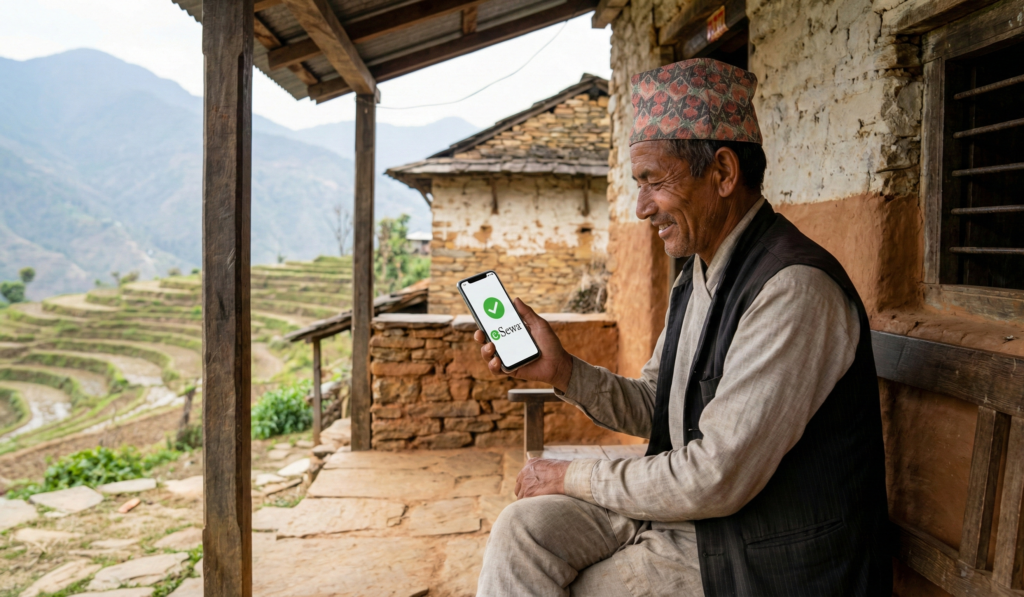
Look at the smile on his face. That’s the look of someone who has just been given a powerful tool. A tool that connects him to the rest of the world, financially.
Challenges and the Road Ahead: It’s Not All Smooth Sailing
Of course, no revolution is without its challenges. We can’t paint a completely rosy picture.
- Digital Literacy: While many people know how to use TikTok or Facebook, using a financial app requires a different level of digital literacy. There is a constant need for education on how to use these apps safely, how to protect your PIN, and how to spot scams.
- Internet Connectivity: You can’t have a digital payment revolution without the internet. While mobile data coverage has improved dramatically, there are still many pockets of Nepal where the connection is unreliable. A transaction that fails due to a bad network can be incredibly frustrating and can erode trust.
- Cybersecurity: As more money moves online, the risk of fraud and cyberattacks increases. The platforms themselves need to be robust, and users need to be vigilant. We hear stories of phishing scams and people getting tricked into giving away their OTPs. This is a real threat.
- Interoperability: For a long time, if you had eSewa and your friend had Khalti, it was difficult to send money between the two. Thankfully, this is changing with initiatives like Nepal Clearing House’s connectIPS and the push for a unified QR code standard. But true, seamless interoperability across all platforms is still a work in progress.
Despite these challenges, the trajectory is clear. The future of finance in Nepal is digital.
Conclusion: A Digital Nepal in the Making
We are witnessing a historic shift. The move from a cash-based society to a digital one is not just about convenience; it’s about efficiency, transparency, and inclusion.
It’s about the student in Kathmandu who can pay for their exam form at 11 PM without worrying about bank hours. It’s about the small business owner in Pokhara who can sell their handicrafts to a customer in London and get paid instantly. It’s about the grandmother in a remote village who can receive support from her family without leaving her home.
Digital wallets like eSewa, Khalti, and IME Pay are not just apps; they are the infrastructure for a modern, connected Nepal. They are empowering individuals, boosting businesses, and shrinking the gap between the urban rich and the rural poor.
As we move forward, the integration of these wallets with government services is the next big frontier. Imagine paying your land tax, getting your driver’s license renewed, or even receiving your pension directly into your digital wallet. It’s all possible, and it’s happening faster than we think.
So, the next time you scan a QR code to pay for your morning cup of tea, take a moment to appreciate it. You are not just paying for tea; you are participating in a revolution.
What has your experience been with digital payments in Nepal? Do you still prefer cash for certain things? Let me know in the comments below!