Do you remember where you were in that first week of September 2025? I think most of us were doing the same thing: frantically trying to find a working VPN, refreshing our news feeds, and asking our friends, “Is this actually happening?”
When the videos started coming out—first of the police shooting at students in Maitighar, and then the unbelievable footage of the parliament building on fire—it felt like watching a movie. But it wasn’t a movie. It was Kathmandu. It was our friends, our siblings, and our streets. For a few days, it felt like the whole country had stopped breathing.
Now that things have calmed down a bit, and we have an interim government preparing for elections in March 2026, it is easy to forget how scary and confused we all felt. We are seeing a lot of “expert” analysis from foreign journalists and old politicians. But as a normal Nepali guy watching all this, I think the story is both simpler and more complicated than what they are saying on TV. Let’s talk about what really happened, without the fancy words.
What Was Going On Before This Happened
To understand September, you have to look at the years before it. If you are young in Nepal, you know the vibe. For a long time, the general feeling has been: “This country is broken, let’s just get a passport and leave.”
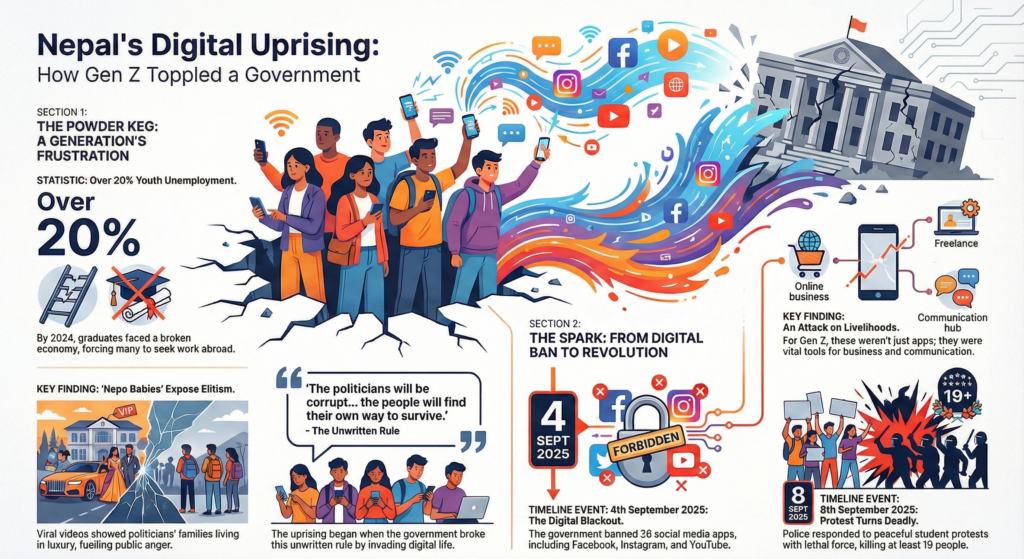
The numbers back this up. By 2024, unemployment for people our age (18-24) was over 20%. For university graduates, it was even higher, around 26%. Every year, about 5 lakh young people enter the job market, but only about 10% find actual formal jobs. The rest of us? We hustle, we work without contracts, or we go to the manpower agencies to apply for jobs in Qatar, Malaysia, or if we are lucky, Australia or the USA.
But it wasn’t just about being broke. It was about watching who was getting rich. Just before the protests started, there was that huge trend on TikTok and Reddit about “Nepo Babies” or “Nepo Kids.” We all saw those videos. They showed the children of our politicians driving luxury cars, partying abroad, and wearing brands that cost more than our parents earn in a year.
It made us angry because it showed us that there is money in Nepal—it’s just stuck in the pockets of a few powerful families. We were already frustrated. We were already feeling hopeless. We were just waiting for a spark.
What Actually Triggered Everything
The spark came on September 4, 2025. The government, led by Prime Minister K.P. Sharma Oli, decided to ban 26 social media apps. They took away Facebook, Instagram, WhatsApp, YouTube, and X (Twitter).
The government said it was about “registration requirements” and “taxes.” They also talked about controlling hate speech. But come on. They gave these platforms one week to comply, and then just pulled the plug. Interestingly, they didn’t ban TikTok, which many people think was because of pressure from China.
For the government, these were just “apps.” But for us, this was our life. In a country where the formal economy is broken, social media is how young people make money. It’s how we sell clothes, promote local businesses, talk to our families abroad, and get our news. When they cut that off, they weren’t just stopping us from scrolling; they were attacking our livelihood and our voice.
The protests started peacefully. On September 8, thousands of students gathered at Maitighar Mandala. Many were still in their school uniforms. They were holding banners asking to “Shut down corruption, not social media.”
Then, everything went wrong. The police responded with lethal force. They used water cannons and tear gas, but then they started using live ammunition. At least 19 people died that day. One of them was just a 12-year-old kid. When the police kill a child and students in uniforms, the fear goes away and is replaced by pure rage. That is when the protests turned into an uprising.
What This Was Really About (My Take)
I don’t think people burned down the parliament building just because they couldn’t use Instagram. That is a shallow way to look at it.
In my opinion, this was about the breaking of an unwritten contract. For decades, the deal in Nepal has been: “The politicians will be corrupt and useless, and the people will find their own way to survive, usually by leaving the country.” We didn’t expect the government to help us, but we expected them to leave us alone.
When they banned the digital platforms, they invaded the one space we had created for ourselves. It felt like they were saying, “Not only will we not give you jobs, but we will also take away your ability to speak and connect.”
The “Nepo Baby” trend was important because it removed the mask. It showed that while we were lining up for passports to go work in 50-degree heat in the Gulf, the politicians’ families were living like kings here in Kathmandu. The ban was just the final insult. It was the moment Gen Z decided that if we didn’t fight back now, we would have nothing left to fight for.
Things We Often Miss When Talking About This
Now, here is the part where we have to be honest. It feels good to say “Gen Z saved Nepal,” but the reality is messy.
1. The Violence Wasn’t All Us On September 9, when the parliament was stormed and set on fire, and when leaders’ homes were burned, it wasn’t just students. There were reports of “unwanted elements” joining the crowd. We know how politics works here. Cadres from different parties (even the coalition partners) used the chaos to attack their rivals. Some of the burning looked planned, not just spontaneous anger. It is scary to think that political gangs might have used our movement to settle their own scores.
2. The “Leaderless” Problem We are proud that this was a leaderless movement, organized on Discord and VPNs. But that also created confusion. When PM Oli resigned, there was nobody to take charge. The vote for the interim Prime Minister happened on a Discord server. Sushila Karki got 49.7% of the vote. That means half the people voting wanted someone else. That is a very shaky foundation for a government.
3. The Compromise We didn’t exactly get a “Gen Z Government.” We got Sushila Karki. She is a 73-year-old former Chief Justice. She is respected and has a reputation for being tough on corruption, which is great. But the cabinet is mostly “technocrats”—former bureaucrats and experts. It was a compromise. The President and the Army basically said, “Okay, the kids are angry, let’s put someone respectable in charge to calm them down.” It’s a victory, but it’s not a total revolution.
4. The Geopolitical Shadow We also need to talk about our neighbors. India was very nervous about the instability next door. And the fact that TikTok (a Chinese app) was exempted from the ban while American apps were blocked made a lot of people suspicious about Chinese influence. We like to think this is just about Nepal, but big powers are always watching us.
What This Could Mean for Nepal Going Forward
So, where are we now?
In the short term: We have an interim government. Sushila Karki has promised to hold elections in March 2026. She is focusing on rebuilding the infrastructure we lost (like the parliament building and server rooms) and investigating corruption. The ban on social media was lifted quickly after the violence, so we have our digital lives back. But the mood is still tense. People are watching every move the government makes.
In the long term: This is the big question. We managed to kick out a Prime Minister, which is huge. We showed the old men in power that they are not untouchable. Seeing powerful leaders having to hide or run away has changed the psychology of the country. They are afraid of us now, and maybe that is a good thing.
But I worry about the election in 2026. Gen Z is great at protesting, but we are not great at organizing political parties. We don’t have a single unified “Youth Party” yet. If we aren’t careful, the same old parties—the Congress, the UML, the Maoists—will use their money and organization to win the election again. They might just change the faces at the top, but keep the system the same.
Also, the economy is hurt. Tourism took a hit because of the burning buildings. Remittances are shaky because of visa issues. We need jobs, not just a new PM. If the next government doesn’t fix the economy, we will just be back on the streets in a few years.
Common Questions People Are Asking
Q: Did the government really ban apps just because of taxes? It is complicated. They said it was because the platforms didn’t register and pay the new Digital Services Tax. But most people think that was just an excuse. The ban happened right after the “Nepo Kids” videos went viral and embarrassed the politicians. It feels like they used the tax law as a weapon to shut down criticism.
Q: Who is running the country right now? Right now, it is Sushila Karki. She is the Interim Prime Minister. She used to be the Chief Justice of the Supreme Court. She is the first woman to run the country, which is historic. She isn’t a politician from any party; she was chosen because she is seen as neutral and honest. Her job is basically to keep things running until the election in March 2026.
Q: Is it safe now? Mostly, yes. The violence stopped after the interim government took over in mid-September. The army went back to the barracks, and the curfews are gone. But the political situation is still fragile. Everyone is waiting for the election. The anger hasn’t gone away; it has just paused.